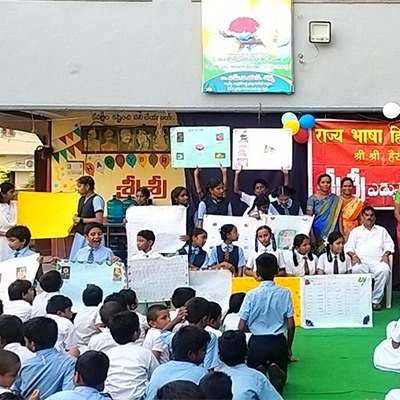



A few months ago, one of our Grade V students found a fifty-rupee note near the water cooler. No one was watching. He could have slipped it into his pocket and no one would ever have known. Instead, he walked it straight to the staff room and handed it over. When his teacher asked why, he shrugged and said, “It isn’t mine, madam.”
That small, unremarkable moment is, honestly, the whole point of what we do. You can measure marks. You can’t easily measure a child who does the right thing when nobody is looking. And yet that is exactly what most parents mean when they type “best school with ethics in Eluru” into their phones late at night.
“Ethics” is easy to print on a banner
Almost every school in Eluru will tell you it teaches values. It looks lovely on a brochure. But a value that lives only on the wall isn’t really a value — it’s a decoration. Children are far too sharp to be fooled by a poster. They learn honesty by watching how a teacher returns extra change, how a classmate is treated when they fail a test, how the school responds when someone tells the truth about a mistake.
So when we talk about being a school with ethics, we don’t mean we run a moral-science period once a week and tick a box. We mean we try — imperfectly, every single day — to make good behaviour the ordinary, expected way of doing things.
How we actually try to teach values
There is no magic to it. It comes down to a hundred small, repeated things:
- Ethical classes that use real situations, not just definitions. What would you do if your friend cheated? If you broke something and could blame someone else? We talk it through, together.
- Teachers who model it. Our staff know the children are always watching. Patience, fairness and honesty from an adult teach more than any lecture.
- A calm start with Yoga and Pranayama. A settled child is a kinder child. It’s hard to be thoughtful when you’re agitated — more on that in our piece on morning yoga.
- Owning up without fear. A child who is terrified of punishment learns to hide. We’d rather a child feel safe enough to say “I did it, I’m sorry.”
We’d take an honest child with average marks over a dishonest topper any day. Thankfully, we’ve found you rarely have to choose — the two grow together.
What to look for when you visit a school
If you’re a parent comparing schools in Eluru, don’t just read the values page. Go and feel the place. A few honest questions worth asking:
- How do teachers speak to children who are struggling — with patience or with pressure?
- What actually happens when a child owns up to a mistake?
- Are the students relaxed and polite with each other, or only when the principal walks in?
- Is there time in the day for reflection, prayer, or quiet — or is every minute a race?
The answers you’ll find in the corridors, not the prospectus.
Why it matters more than ever
Children today grow up faster and with more noise around them than any generation before. Marks will open a door for them; character decides what they do once they walk through it. A strong moral foundation — honesty, empathy, discipline, responsibility — is the one thing that keeps working long after the exam is over.
For nearly four decades in Eluru, that belief has been the quiet centre of everything at Sree Sree Educational Society. You can read more about who we are and our approach to academics and values — or, better still, come and see it for yourself.
If a school where your child learns to be good, not just to score well, is what you’re after, we’d love to meet you. Come visit our campus — the fifty-rupee note will probably still be in the staff room, waiting for its owner.