


A parent asked us recently, quite reasonably, why a school in Eluru teaches robotics to nine-year-olds. “They can learn all this in engineering college,” he said. “Right now, let them study.”
It’s a fair challenge and we gave him an honest answer, which we’ll give you here. We don’t teach robotics to produce engineers. We teach it because of what happens to a child in the twenty minutes before the machine finally works.
What actually happens in a robotics class
Picture a group of Grade 5 children with a small robot that is supposed to follow a black line. It doesn’t. It veers off and stops.
Now watch what they do. They can’t argue with it. They can’t charm it. There is no marks-based partial credit for an attempt. The robot simply doesn’t work, and the only way forward is to think: what did we tell it to do, and how is that different from what we wanted?
They change one thing. Test. Still wrong. Change another. Test. And then, at some point, it works — and the room erupts.
That loop is the whole point. Guess, test, be wrong, adjust, try again. It is exactly how science works, how engineering works, and honestly how most of adult life works. Very little else in a school timetable teaches it as cleanly.
In most of school, a wrong answer is a small failure. In robotics, a wrong answer is just information. Children who spend a year in that environment become noticeably braver about being wrong.
Why we start early rather than in high school
By around Grade 8, many children have already decided who they are. “I’m not good at maths.” “I’m not a science person.” Those sentences, once settled, are extremely hard to shift.
A ten-year-old hasn’t decided yet. Give them something they can build with their hands that visibly works, and you plant a different idea: I can make things happen. That belief matters far more than whatever they remember about sensors.
There’s a second reason, and it’s about who ends up in the room. When technology is introduced late and as an elective, the children who choose it are the ones who were already confident about it — usually the same handful, usually mostly boys. When every child does it in Grade 4 because it’s simply part of the timetable, that filtering never happens. We think that matters.
And what about AI?
Your child is growing up alongside machines that write, draw, answer and converse. This is not a prediction; it’s already the case. The question is not whether they will use these tools, but whether they’ll understand them.
We are not teaching primary children to build neural networks. What we’re teaching is more useful and more urgent:
- That a machine learns from examples. Show it a thousand pictures of a cat and it learns “cat”. Show it only white cats and it will be confidently wrong about a black one. Children grasp this immediately, and it explains most of what they need to know about AI.
- That a confident answer can be a wrong answer. This may be the single most important thing a child can learn about these tools. It is also a rather good lesson about the internet, and about people.
- That someone chose what went in. Machines reflect the choices and the blind spots of the people who built them. A child who understands that will never be quite as easily fooled.
- That the tool doesn’t do the thinking. It can produce an essay. It cannot tell you whether the essay is any good, or whether it’s true, or whether it’s worth writing.
The skills that transfer
Most children in our robotics classes will not become roboticists, and that’s entirely fine. What they take with them shows up elsewhere:
- Breaking a big problem into steps. You cannot tell a robot to “go around the obstacle”. You have to decompose it. That habit transfers straight into maths word problems and, later, into essays.
- Precision. A missing semicolon or a reversed wire and nothing works. Children who have felt that stop being careless in ways a red pen never achieved.
- Working in a pair. One builds, one programs, and they have to talk to each other clearly. Most of our robotics learning is actually social.
- Persistence. The line-follower takes forty minutes and eleven attempts. That is the real curriculum.
Isn’t this a distraction from the syllabus?
We’d argue the opposite, and it’s the same argument we make about the twenty minutes of yoga we protect each morning. A child who has spent an hour patiently debugging is a child who sits down to a difficult maths problem differently.
Robotics also gives abstract subjects something to attach to. Angles stop being a diagram when your robot needs to turn ninety degrees and turns eighty-five. Ratios stop being a chapter when your wheels are the wrong size. Children who have built something carry the concept differently.
What it looks like here
Robotics and AI sit alongside chess, karate and sport in our co-curricular programme — not as a weekend extra for a few, but as part of what every child does. Work happens in our computer lab, in pairs, with a good deal of noise and the occasional robot going in entirely the wrong direction.
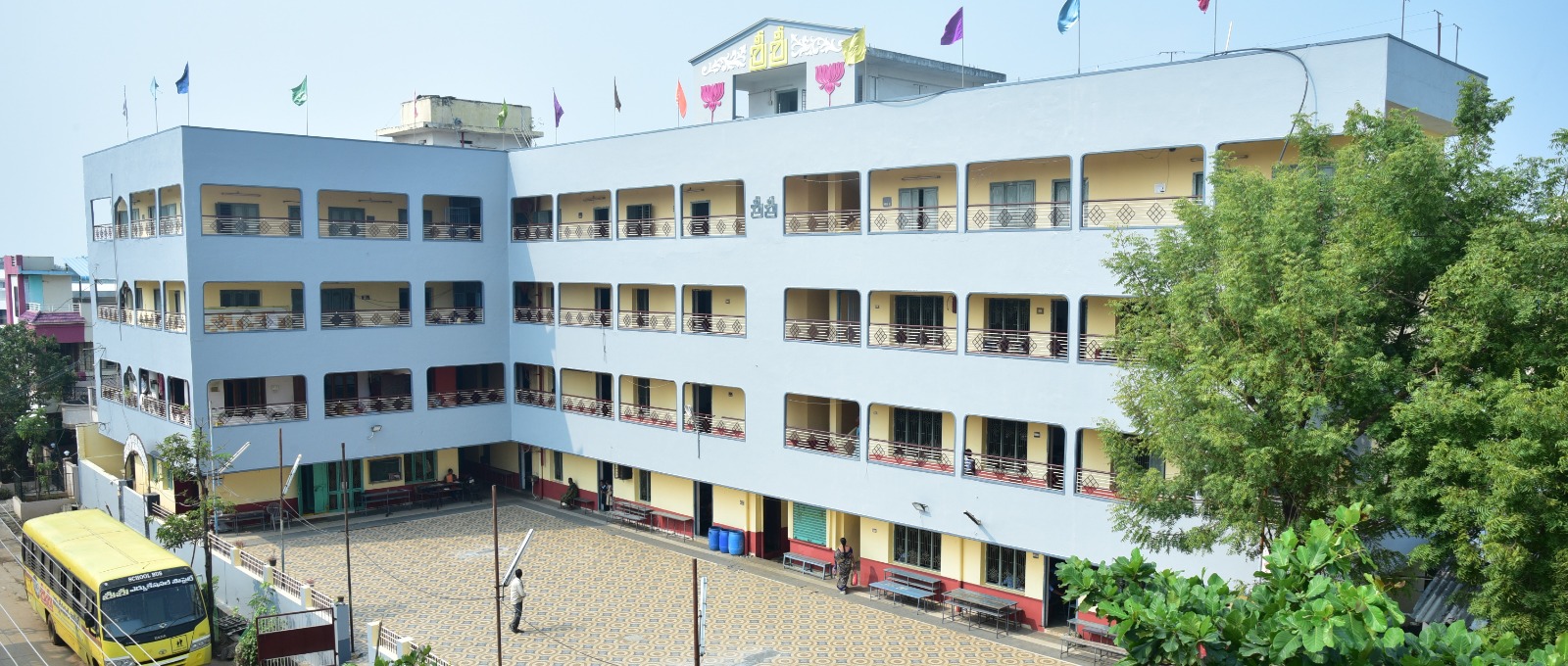
For a school that has been here since 1987, this might look like a departure. We don’t see it that way. Our founder built this place around the idea that a child should develop in mind, body and character together. A robotics table is simply a modern place to practise patience, precision and honest thinking about what went wrong.
Come and see a class — it is more fun to watch than to describe. Arrange a visit to our campus in Eluru, or read more about why life beyond the classroom matters to us.